

Once you’ve got the offer letter, it’s time to start your search for student accommodation in the UK.
Studying in the UK has a lot to offer – high-quality education, career opportunities, cultural diversity, and vibrant cities.
Having the right place to stay will have a significant impact on your experience.
Knowing the options and their differences will help you choose what’s right for you.
In this article, I’ll share accommodation options you could look into as a student.
1. Purpose-Built Student Accommodation
Halls of residence are the most common accommodation option for university students.
They are university-owned or private.
(a) University-Owned Halls

Usually only available to first-year students.
They make the transition to university life smoother.
(i) Pros
These are usually on-campus, therefore are very close to your lectures and other university facilities, such as the library.
They are normally fully furnished and are inclusive of utility bills.
However, they are basic in aesthetics and the amenities available.
For first-year students, it eliminates the hassle of having to search.
The application, contract, deposit, and payment are through the university, which makes it convenient.
You’ll feel more taken care of in university-owned accommodation when you are starting.
If you are getting a room in halls, then get an ensuite room, budget allowing, of course.
I’ve heard from friends who’ve lived in halls, that bathroom sharing can become an unpleasant experience.
There will be a shared kitchen for the rooms on a floor.
This is a great way to meet new people and make friends.
Try and get along with people so you can have an enjoyable living situation.
(ii) Cons
One downside of halls is the contract lengths.
They have fixed contract lengths which are usually longer than the academic year, which might not suit everyone’s needs.
It’s rare to find halls with extras such as a gym, or a cinema room.
(iii) Price
Pricing-wise, halls are relatively more expensive than private student accommodation, which I’ll discuss next.
(b) Private Student Accommodation
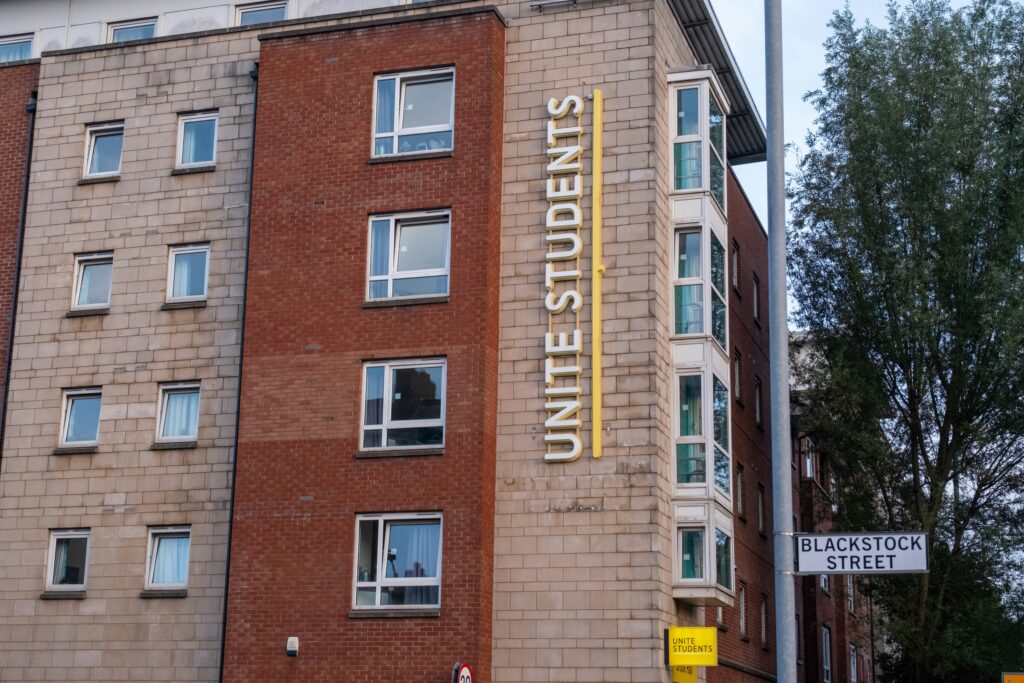
Private companies, such as Unite Students and Canvas, provide purpose-built student accommodation in cities across the UK.
(i) Pros
The rooms are modern and fully furnished, ranging from en-suite rooms to studio rooms.
They are inclusive of utility bills, including high-speed wi-fi.
They are also more aesthetic with more amenities and some flexibility to personalise your space.
Amenities include communal areas, cinema rooms, and outdoor spaces.
Additionally, you get added perks, such as an on-site gym or complimentary gym membership, study areas, and events organised by the student accommodation.
These accommodations are located at varied distances from campus, with some being a short walk away and others a short bus ride away.
As I mentioned in my first post, for international students, these accommodation providers offer a visa money-back guarantee.
On the extremely rare occasion that your visa gets rejected, you get your deposit/full rent back.
However, please double-check that this guarantee is being offered before booking (if you are booking before receiving your visa).
Shared areas, such as the kitchen, would be cleaned by housekeeping every week or fortnightly.
Some even offer catered packages where meals are provided.
(ii) Cons
Similar to halls, lease terms are fixed with less flexibility, often requiring commitment for the full academic year.
(iii) Price
They range in price depending on the quality of the accommodation.
Some might be cheaper or the same price as halls.
Others, where the overall standard of living is higher, are more expensive. They have better facilities that are designed to a higher spec than other options.
Vita Student is an example of a company that provides high-end student accommodation.
It’s worth looking at different options to find something that suits your budget.
2. House of Multiple Occupation (HMO)
As the name suggests, these are houses occupied by multiple people.
They are shared houses of between 4 to 10 students.
Second and third-year students usually prefer them.
What usually happens is that these students make friends in their first year, then move into a shared house together for their following years.
You get to choose your housemates, so happy days!
HMOs are owned by private landlords.
(i) Pros
Typically, utility bills are not included in the rent.
The tenants are required to manage utilities, general maintenance, and upkeep of the house, including cleaning of shared spaces, such as the kitchen and living room.
Responsibilities have to be agreed upon between the group to prevent conflicts.
The independence and maturity you develop during this experience can be valuable.
Flexibility is another advantage of HMOs. The lease duration typically ranges between 6 – 12 months.
Others have the option of a rolling contract as well. Here, instead of a fixed-term lease, you have a monthly rolling contract.
The advantage is, if you don’t like it, you can leave the house with a month’s notice.
However, the same applies to the landlord or estate agent as well. They can equally ask you to leave with a month’s notice.
This puts you in a difficult situation, as finding accommodation is no easy feat!
Another disadvantage is that rent can be increased at any time during the tenancy.
But, more about renting in the UK in a different blog. Stay posted!
(ii) Cons
One disadvantage of HMOs is the potential for conflicts.
They can be caused by a number of reasons.
Firstly, the bills. The split might seem unfair depending on people’s usage.
Cleaning the shared spaces is another one. People have different expectations of cleanliness, and when these are not met, it can cause fights.
For example, you might have agreed for each flatmate to clean the kitchen after they’ve finished using it, or set days to clean the living room in turns.
When a housemate fails to do this, it can lead to disagreements.
The others might feel like they are having to shoulder someone else’s responsibility.
HMOs can be located far from campus, which would necessitate a commute.
But that’s not to say you can’t get a house closer to the university.
An important thing to be mindful of is the quality of the house.
These houses are privately owned, so they vary hugely in quality.
It will take some shopping around to get a house that fits your group’s budget and is in good condition. Be persistent.
(iii) Price
HMOs are cheaper compared to purpose-built student accommodation and rented flats.
Spareroom is a good website to find house shares.
3. Rented Apartment

If you’ve got more budget to spend on your accommodation, then rented apartments can be a good option.
Your budget will determine the quality of the flat or house you can get.
Though I must point out, it is hard for students to get a rented apartment.
Most landlords/landladies usually require the tenant to have a certain income before they can consider their application.
As a full-time student, you won’t meet this income requirement.
But, I’ve put this as an accommodation option for students in the UK in this article, because there are apartments for which applications from students are accepted.
Rightmove, Zoopla, and On the Market are good websites for searching for houses to rent.
(i) Pros
I have noticed that 2 people renting a 2-bedroom house works out cheaper than an individual renting a 1-bedroom.
This can be a cost-saving option if you have a friend who’s willing to rent with you.
Flats are everywhere across the city, so you choose where to rent.
However, flats in the city centre tend to be comparatively more expensive.
Modern developments can come with additional perks, such as an on-site gym, a concierge service, and a rooftop garden.
Rented apartments are typically managed by letting agencies, which generally ensure a certain standard of maintenance and service.
(ii) Cons
Another important tip, based on personal experience, go for a furnished apartment.
Although unfurnished apartments are cheaper, setting up a home is hard!
Looking for furniture and appliances and putting these together can be a difficult process.
Especially when you’re a student. You want to be focusing on settling in quickly and hitting the ground running, so you can make the most of your university experience.
Don’t put the extra hassle of setting up a home on yourself.
Not having the right facilities in your house can have a negative impact on your day-to-day living.
(iii) Price
Renting is the most expensive student accommodation option.
It’s not for those on a limited budget. It is for the well-off students 😜
The rent itself is expensive, and on top of that, bills are not included.
Paying for energy, water, internet, and a TV license further pushes the monthly cost up.
4. Homestays
I have always known these as “paying guests” (PG).
Homestay accommodation is where families rent out a room(s) in their home for short to medium-term stays.
These families are referred to as “hosts”.
Hosts can be single people, young couples, married couples with or without children, and even retired pensioners.
Offering homestay accommodation is a means for the family to make some extra income.
(i) Pros (+Personal Experience)
You will typically have your own room and access to shared facilities in the house, such as the kitchen, lounge, and garden.
Your living arrangement depends on the family.
Welcoming hosts may treat you like family, eating, socialising, and relaxing with members of the household.
Essential services, such as bedding sets, laundry, and meals, are typically provided by the host.
Meal plans vary.
You can be offered bed and breakfast, half-board (including breakfast and evening meal), full-board (all 3 meals), or self-catering (with full access to the kitchen to prepare your own meals).
Inclusive meal plans are a popular option among students because they ensure you eat well, especially after long days at university!
Another benefit of homestays is that they give you a chance to become familiar with the town or city.
You will know what and where to look for your long-term accommodation.
Your choices will be informed, rather than having to get into a long-term contract from when you are still not in the UK.
It helps you settle in, if you like.
And look, you might well like living with your host family, such that you choose to live there for a full academic year.
Though this will depend on your hosts, on whether they’d like to have you living with them long term.
I lived as a PG with 2 different host families throughout my time at university.
Full credit to these 2 families.
I am very grateful to them.
I had an enjoyable experience, and I couldn’t have wished for something better.
In my case, it was different.
My parents knew these families and they asked if I could live with them.
I did not have to search online for my hosts, and they weren’t people who were strangers to me.
However, Student Homestay and Homestay.com are good websites for searching for homestays.
A key driver for me was cost.
I was on a tight budget, and a PG was probably the only option I could afford.
Convenience is another factor.
Bear in mind that these are people’s homes, which are fully set up for day-to-day living.
You won’t have to worry about buying cooking pots and furniture, or sourcing a reasonable yet decent internet provider.
(ii) Cons
Unless you have a bad host, I don’t really see negatives of living in a homestay.
You are not bound by a contract, if your host is bad, then you can leave.
(iii) Price
Homestays are the most affordable accommodation option for students.
Other students, particularly international students, live with their relatives when they first move abroad.
Lucky are the students who have their parents’ siblings living in cities with good universities.
Their accommodation is free!
5. Living at Home
Contrary to the popular mindset of “moving out”, living at home comes with a lot of benefits.
If there is a reputable university in your city or within a commutable distance offering your first choice course, then it’s worth considering living at home.
Advantages of living at home outweigh the drawbacks.
(i) Pros
The first obvious benefit is cost.
This accommodation option is free.
You continue living with your family just like you have until this point.
However, you need to factor in the cost of commuting.
In my opinion, public transport in the UK is generally cheap for students.
And I say this from experience, because I commuted to university by public transport for my 4 years of university.
As I mentioned in my article on the things you should do when you first arrive in the UK, in my first year, I spent £270 on a West Midlands student term pass, which included unlimited travel on buses, trains, and the tram.
Pretty good value, right?
The cost would be more if you are driving, as there will be fuel, parking, and car maintenance expenses.
However, it makes the commute so much more convenient.
You can travel at times of your choice, and you won’t be susceptible to the dangers of delays and strikes.
You can also attend social events that are later in the evening, something I couldn’t do because of public transport limitations.
Traffic jams can be a pain, though. But you can easily avoid these by working your commute to fall in off-peak travel times.
Whatever travelling means you use, it would work out a lot cheaper than paying for rent, utility bills, and groceries.
Depending on your commute, you can use this time to catch up on revision.
For example, you can read up on a topic during your 30-minute train ride.
When you’re at home, you don’t have to worry too much about household chores.
Especially cooking.
If you are getting well-prepared meals and the chance to dine with your family every day, then you can’t ask for more.
It is better than surviving on noodles!
You have to help out at home, 100%, but running the house is not solely your responsibility, freeing up more time for you to focus on your university work.
There is a point about becoming more independent when you move out and live by yourself.
Surely you can learn how to clean and do laundry in your own home too, right? 😁
(ii) Cons
A common concern for those considering staying at home and commuting is the social aspect of university life.
Whether they will be able to make friends as easily as they would in halls, or if they will be able to attend parties.
This concern is valid to an extent.
It is easier and more convenient to make friends and attend events if you are living in student accommodation.
But that’s not to say that if you are living at home and commuting, you cannot have the full university experience.
It will just require a bit more effort.
You can make friends with your course mates, or make friends outside your course by joining societies and sports clubs.
Societies meet and sports clubs train usually after lectures in the evening.
If you have lectures on the day and have to be on campus anyway, then you can just stay back to attend these sessions and return home slightly later on the day.
As for parties, if your friends live near campus, would they mind letting you crash at their place for a night?
Managing your energy is important if you are commuting.
A long commute will drain your energy.
This leads to low motivation to study when you reach home.
You can create a revision timetable to overcome this.
Studying during long gaps between lectures and on the days that you don’t have to go to campus is a good idea.
Or, you could wake up early and study before you travel to university.
Once you figure out what works for you, it is manageable.
Conclusion
Your accommodation choice will ultimately depend on your budget.
Each accommodation type has its pros and cons as covered in the article. Weigh the advantages and disadvantages and choose the one that works best for you.
For your first year, I recommend opting for safer options, such as halls, private student accommodation, or a homestay.
Once you are familiar with the city, have gained experience of how things work, and have made good friends, you can look into the other accommodation options for your following years at university.
Whichever option you go for, I’m sure you’ll be fine.
What type of accommodation seems most suitable to you?